
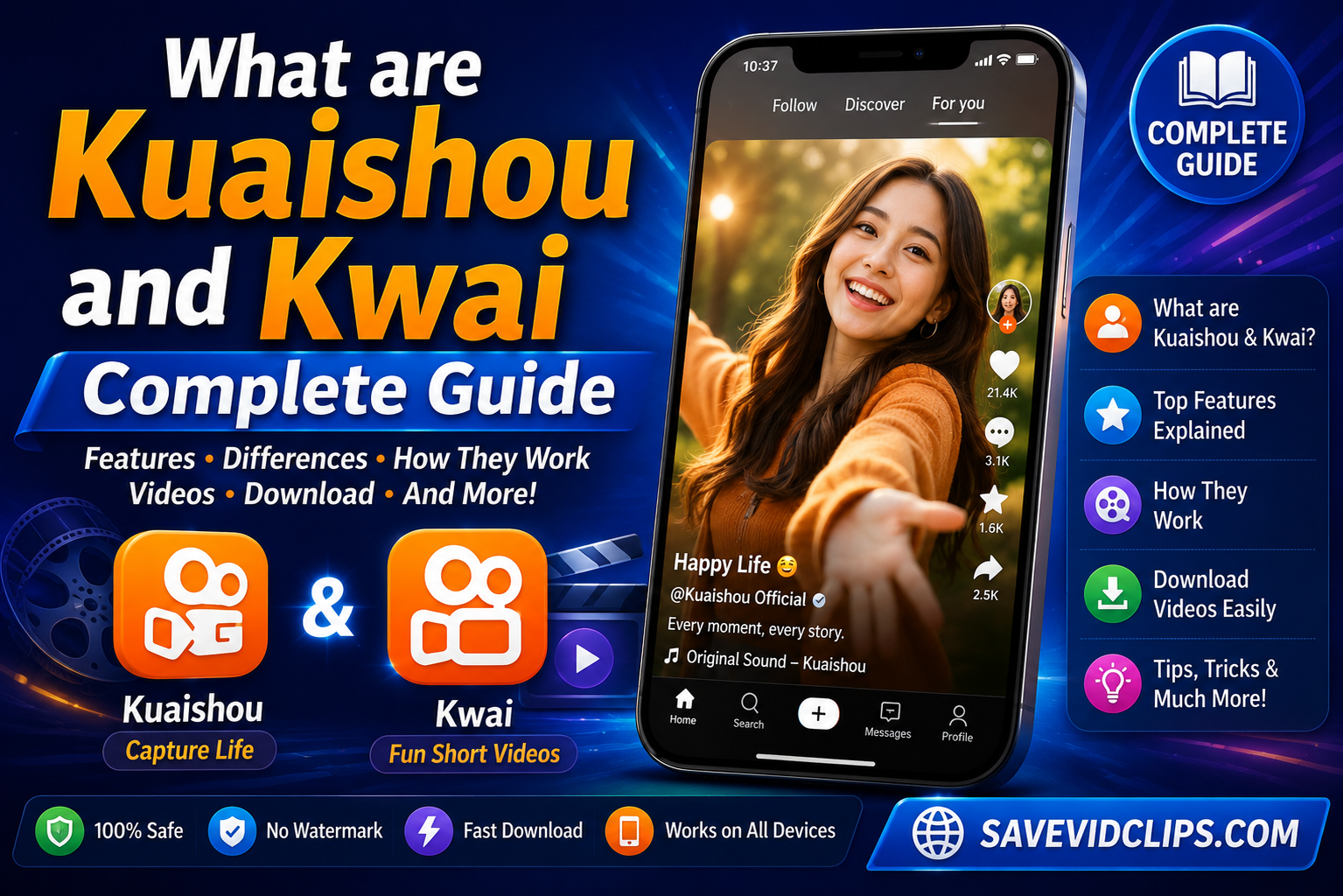
What are Kuaishou and Kwai? Complete Guide
KEY Takeaways
- Kuaishou = the Chinese app name (快手, meaning “Fast Hands”). Kwai = the international brand used in markets like Brazil, Indonesia, India, and the Middle East.
- Founded in 2011 by Cheng Yixiao and Su Hua; publicly listed on the Hong Kong Stock Exchange in February 2021.
- As of Q2 2025: 715 million monthly active users (MAU), 409 million daily active users (DAU), and revenue of ¥35 billion (up 13.1% year-over-year).
- It competes directly with TikTok/Douyin (owned by ByteDance) but targets a different audience — users in China’s smaller cities and rural areas.
- Kuaishou now has an AI video generation tool called Kling AI, which has generated significant commercial attention.
- You can download Kuaishou and Kwai videos without a watermark using SaveVidClips.com .
What Is Kuaishou? The Plain-English Answer
If you’ve heard the name Kuaishou but aren’t sure what it actually is, here’s the short version: it is a short-video social platform, similar to TikTok in format but different in feel.
The name 快手 (Kuài Shǒu) translates literally to “Fast Hands” in Chinese — a nod to speed and skill. When the app launched in 2011, it began as a simple GIF-making tool on platforms like Weibo and Renren. By 2013, co-founder Su Hua joined and steered the team toward a full video-sharing community. That pivot turned out to be a defining move.

Today, Kuaishou sits alongside Douyin (TikTok’s Chinese version) as one of the two dominant short-video platforms in China. But while Douyin tends to attract users from major metropolitan centers, Kuaishou built its massive audience in China’s Tier 3, Tier 4, and rural markets — a strategic positioning that has made it deeply rooted in communities often overlooked by other platforms.
Kuaishou vs. Kwai: What’s the Difference?
This is one of the most common questions people ask, and the answer is simpler than it sounds.
Kuaishou and Kwai are the same product operated by the same parent company — Kuaishou Technology, headquartered in Beijing, China. The distinction is purely geographic branding:
Kuaishou
快手 · China
Kwai
International
Live commerce
Esp. Indonesia
In Brazil alone, Kwai had more than 45 million monthly active users — roughly 20% of the national population — as of late 2024, with DAU growing 9.7% year-over-year. The platform has also launched a full-scale cross-border e-commerce solution in Indonesia with local logistics partners in mid-2025, further deepening its international strategy.
A Brief History of Kuaishou
Understanding where Kuaishou came from helps explain what makes it tick today.
2011: Cheng Yixiao builds GIF Kuaishou, a simple app for creating and sharing animated GIFs. It spreads quickly on early Chinese social platforms.

2013: Su Hua joins and refocuses the product toward short-video sharing. The community grows organically, particularly among users in smaller cities.

2016–2018: The short-video explosion in China benefits both Kuaishou and the then-emerging Douyin. Kuaishou reaches hundreds of millions of users.
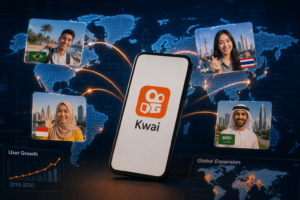
2019–2020: International expansion begins. The app rebrands as “Kwai” for overseas markets and starts competing seriously with TikTok in Brazil, Southeast Asia, and the Middle East.
2024–2025: The company undergoes what its leadership describes as an “AI-First pivot.” It launches Kling AI — a generative video model — and integrates AI across content discovery, e-commerce, and creator tools.

How Kuaishou Actually Works: Core Features Explained
Short Video Feed
The homepage is a dual-feed system. Unlike TikTok’s single algorithmic feed, Kuaishou historically offered users both a “Following” feed (showing content from people you subscribe to) and a “Discover” feed (algorithmically recommended content). This design reflects the platform’s community-first philosophy — it values human connections alongside viral content. Visit the detailed guide on How to convert Kuaishou audio to MP3
Live Streaming
Live streaming is one of Kuaishou’s oldest and most profitable features. Viewers send virtual gifts to streamers during broadcasts; the platform takes a commission of roughly 30–50% on those transactions. By 2025, live streaming accounted for 28.7% of total revenue, making it a pillar of the business model.
Kling AI (AI Video Generation)
Launched publicly in late 2024, Kling AI (可靈AI) is Kuaishou’s generative AI product. It allows users to create videos from text descriptions, with features covering motion, camera movement, style consistency, and lighting. In Q2 2025, Kling AI generated over ¥250 million in operating revenue, with commercialization accelerating. The platform now handles over 20 million unique prompts daily.
Kuaishou Recruitment (Kwai)
A lesser-known feature outside China: Kuaishou runs a large blue-collar job-matching platform with over 250 million monthly active users on its recruitment service. It has partnered with more than 100,000 enterprises — a practical social utility built on top of its existing trust-based user relationships.
Kuaishou E-Commerce (Live Commerce)
Kuaishou transformed from a content platform into a social commerce giant. Sellers showcase products during live streams; viewers buy without leaving the app. In Q2 2025, the platform’s e-commerce Gross Merchandise Volume (GMV) reached ¥358.9 billion — a 17.6% year-over-year increase. The monthly average number of active buyers was 134 million.
More strikingly, over 70% of e-commerce buyers on Kuaishou say they prioritize creator recommendations over brand names. This trust-driven behavior is central to why live commerce works so well here.
Who Uses Kuaishou? User Demographics
Kuaishou’s audience is often misunderstood as “rural China only.” The reality is more nuanced and commercially interesting.
- 70% of monthly active users are under 35 years old, making it a young platform.
- However, users over 40 contribute more than 47% of Kuaishou’s GMV — they are the most commercially active shoppers.
- The DAU-to-MAU ratio holds near 58%, which is unusually high and reflects strong daily stickiness.
- Average daily time spent on the platform is approximately 135 minutes, much of it in interactive live streams.
- Primary demographics are concentrated in Tier 3–5 Chinese cities and rural areas, though urban engagement is growing.
How to Download Kuaishou / Kwai Videos
One of the most common practical questions people have about these platforms is how to save a video they’ve seen. By default, Kuaishou and Kwai let creators choose whether downloads are allowed. If a creator has disabled the download button, you’ll get a watermarked save at best — or nothing at all.
SaveVidClips.com solves this problem. It’s a free, browser-based tool that downloads Kuaishou and Kwai videos in HD and 4K quality, without watermarks, and without requiring you to install any software or create an account.
Here’s how it works in three steps:
- Open the video in the Kuaishou or Kwai app and tap the Share button to copy the link.
- Go to SaveVidClips.com and paste the link into the input box.
- Choose your preferred quality (SD, HD, or 4K) and hit Download.
The tool supports all link formats — short app share links (v.kuaishou.com/...), full browser URLs (kuaishou.com/short-video/...), and international Kwai links (kwai.com/video/...). It works on Android, iPhone, and PC.
If you want a step-by-step walkthrough for saving Kuaishou videos on a computer, see the full guide on How to Download Kuaishou Videos on PC/Laptop. iPhone users should check the dedicated guide on How to Download Kuaishou Videos on iPhone — Free, No Watermark, which covers the Safari share workflow and saving to your Photos app.
Is Kuaishou Available Outside China?
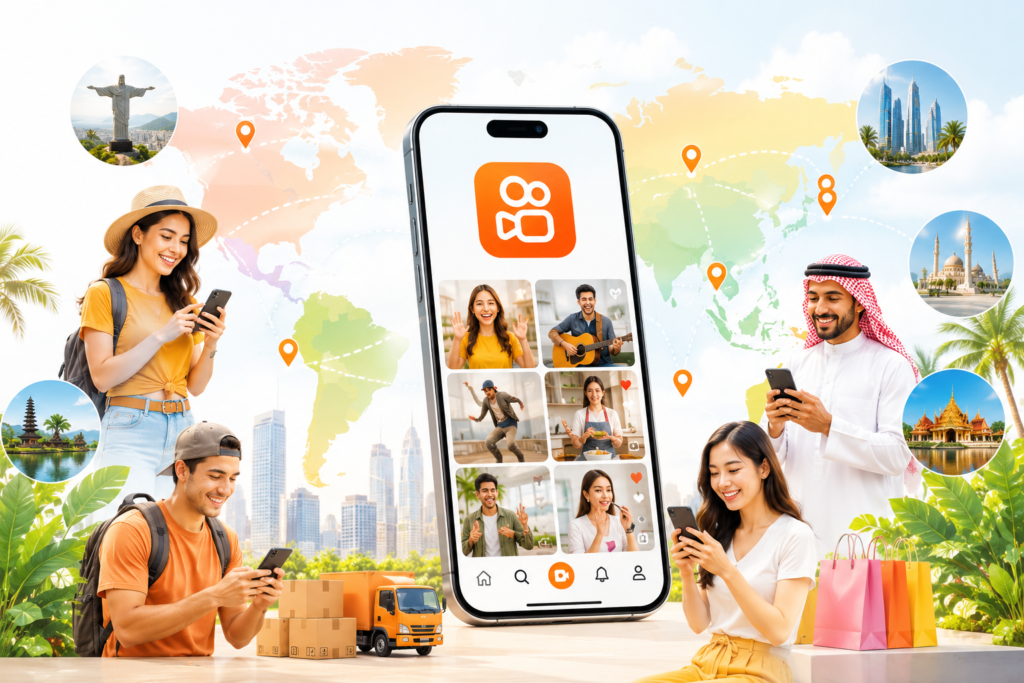
Yes — through the Kwai app, which is available on both the Google Play Store and Apple App Store in most countries. You don’t need a Chinese phone number or VPN to use Kwai internationally. The interface is localized in multiple languages, and content is regionally tailored.
Markets where Kwai has meaningful traction include:
Brazil — the largest international market
Indonesia — growing, with new e-commerce logistics partnerships
India — before the 2020 ban; availability varies
Saudi Arabia and the Middle East — emerging market focus
Malaysia, Thailand, Vietnam — steady growth across Southeast Asia
Privacy and Content Safety on Kuaishou
Users have strong privacy controls: you can choose who sees your content, block or report accounts, and manage data-sharing preferences. This level of control is especially relevant if you’re using the platform for the first time.